ALS-205 — The Evidence
ALS-205 is a small-molecule, orally active, brain-penetrant C5a1-receptor antagonist — the receptor that drives much of the neurodegenerative damage. It has demonstrated improved survival and quality of life in animal models of Alzheimer's and MND and in human subjects safely and functionally engages with its target receptor. It has been granted orphan drug status in both the United States and Europe.
A Selective C5a1-Receptor Antagonist
ALS-205 is a potent and selective antagonist of the human C5a1 receptor with no significant activity at any other receptors, including other complement receptors. It is an insurmountable antagonist, causing a conformational change to the receptor preventing C5a binding and activation. ALS-205 is chemically stable to peptidase degradation in blood and gastric fluids and is orally active at ≤1 mg/kg/day in vivo — readily accessing the brain.
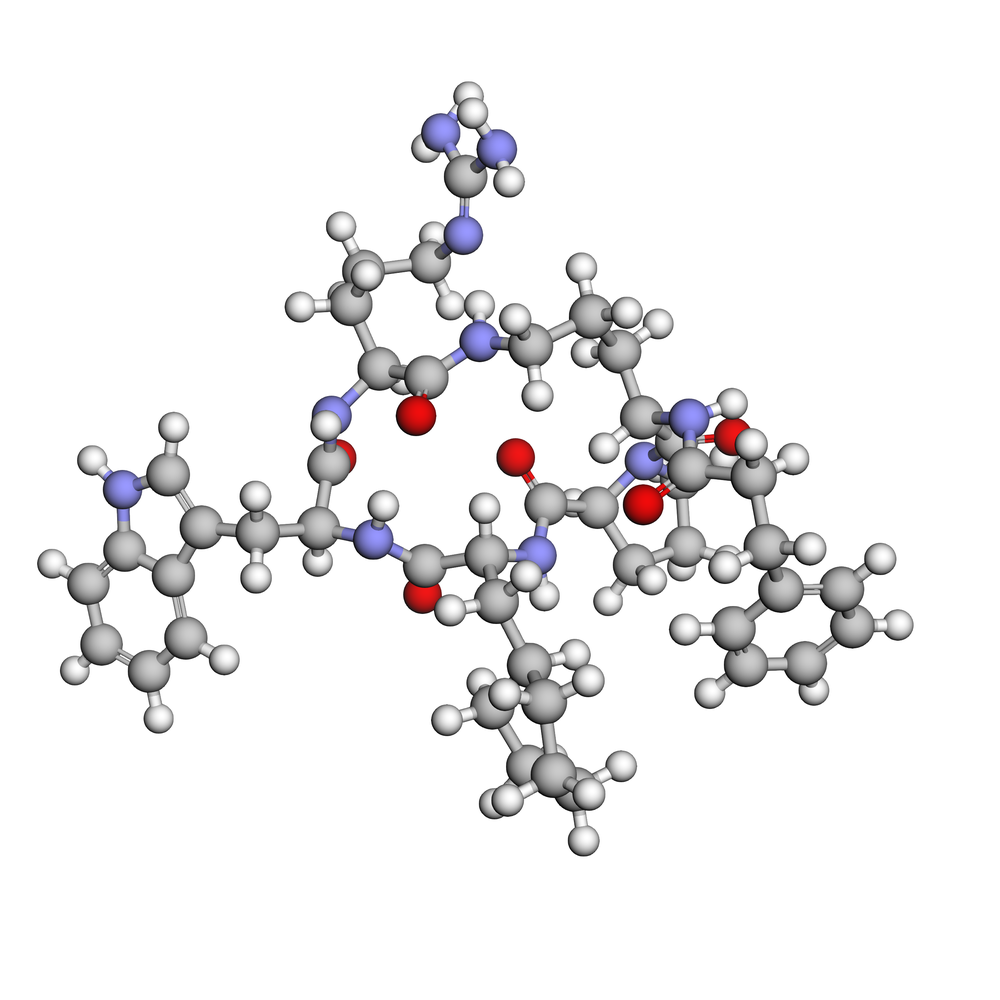
What sets ALS-205 apart is as much how it is built as what it blocks. Most efforts to target the complement system have relied on antibodies and other biologics — large protein molecules that, for all their precision, carry two practical limitations for brain disease. Their size keeps them from crossing the blood-brain barrier in any meaningful quantity, so they struggle to reach the very neuroinflammation that takes hold inside the central nervous system; and being proteins, they cannot survive the gut and must be delivered by injection or infusion — a considerable burden when treatment is lifelong, as it is in neurodegenerative disease. ALS-205 is not an antibody. It is a small molecule that readily accesses the brain with a long receptor residence time making it suitable for once-a-day dosing. Critically, it can get to where the damage is being done, as inhibiting peripheral circulating complement with a C5 antibody or similar is not going to impact complement produced by brain cells.
Three properties, one small molecule: oral, brain-penetrant, and selective for the receptor that matters.
Tested in Volunteers and in Patients
ALS-205 has completed a Single Ascending and Multiple Ascending Dose (SAD/MAD) Phase I clinical trial in healthy volunteers, establishing a safe suitable dose with demonstrable effective binding to the C5a receptor. A Phase Ib clinical trial in subjects with MND has also been completed, demonstrating safe target engagement in the intended patient population and properties suitable for ongoing development.
Together these trials establish what every drug-development programme needs before it can go further: a dose, a safety profile, and evidence that the molecule reaches and engages its biochemical target effectively in people it is designed to help.
ALS-205 in an Animal Model of Motor Neuron Disease
Although the majority of ALS cases are sporadic, approximately 10% are of genetic origin due to missense mutations in the copper-zinc superoxide dismutase 1 (SOD1) enzyme. This has led to the development of transgenic animal models (transgenic SOD1G93A rats) of MND expressing multiple copies of this mutant human SOD1 gene and is a common model of human disease.
The complement factor C5a is a major effector of all complement activation pathways and recruits and activates inflammatory cells. C5a is also produced locally in the CNS and the C5a1 receptor is present on neurons and glia. In addition, in transgenic SOD1G93A rats, significant deposition of complement factor C3/C3b and an up-regulation of the C5a1 receptor and C5a2 receptor in the diseased spinal cord has been shown. Oral administration of ALS-205 to SOD1G93A transgenic rats significantly reduced end-stage (ES) motor-deficit scores and enhanced survival times. This was also associated with reduced astroglial proliferation in the regions of motor neuron degeneration. These studies demonstrated that activation of complement and C5a1 receptors are involved in the progression of disease pathology in transgenic SOD1G93A rats.
Similar findings have been repeated in transgenic mice models of ALS/MND, where survival is improved and the classic deterioration of muscle function is slowed.
From: Woodruff et al. The complement factor C5a contributes to pathology in a rat model of amyotrophic lateral sclerosis. J. Immunol., 2008, 181(12), 8727.
One Molecule, a Widening Clinical Frontier
ALS-205 was developed first for MND, but the rationale — blocking damaging C5a signalling in the brain — applies across neurodegenerative disease. Additional indications expand the clinical utility of the lead molecule into other degenerative diseases of the CNS, and benefit from the preclinical work already undertaken for the first indication.
Orphan-Drug Protection in the US and Europe
ALS-205 has been granted orphan drug designation by the FDA for the U.S. and by the EMA for Europe. The Orphan Designation is a legal procedure that endows drugs with a special status for medicinal substances with therapeutic potential for a rare disease, before its first administration in humans or during its clinical development. The exact therapeutic indication is then defined at the time of marketing authorisation. This procedure has been established in Europe, the US, Australia, Japan and Singapore.
United States
ALS-205 has been granted orphan drug status by the U.S. FDA, which means that Alsonex may obtain the following advantages for the development of ALS-205 for ALS/MND: a 50% tax credit on the cost of clinical trials undertaken in the USA; a seven-year period of marketing exclusivity following the marketing approval; some written recommendations provided by the FDA concerning clinical and preclinical studies to be completed in order to register the new drug; and a fast-track procedure for the FDA to evaluate registration files.
Europe
The main characteristics of the orphan drug legislation in Europe are: a 10-year period of market exclusivity; accelerated market approval via the centralised procedure which provides simultaneous approval in all member states; protocol assistance, a type of scientific advice specific for orphan medicines; regulatory fee reductions; and technical assistance for elaboration of the marketing application file.
- Targeting the C5-C5aR1 axis: A promising therapeutic strategy for Alzheimer's disease and amyotrophic lateral sclerosis by unlocking neuroprotection: Biochem Pharmacol. 2026 Jan;243(Pt 1):117518.
- Knowing the enemy: strategic targeting of complement to treat Alzheimer disease: Nat Rev Neurol 21, 250–264 (2025).
- The complement system in neurodegenerative diseases: Clin Sci (Lond). 2024 Mar 20;138(6):387-412.
- Modulation of C5a-C5aR1 signaling alters the dynamics of AD progression: J Neuroinflammation. 2022 Jul 11;19(1):178.
- The elevation of the terminal complement activation product C5a and C5b-9 in ALS patient blood: J Neuroimmunol. 2014; 276(1-2):213-8.
- Neuroinflammation in amyotrophic lateral sclerosis: role of glial activation in motor neuron disease: Lancet Neurol 2011; 10: 253–63.
- The Role of the Complement System and the Activation Fragment C5a in the Central Nervous System: Neuromol Med 2010; 12:179–192.
- Role for terminal complement activation in amyotrophic lateral sclerosis disease progression: Proc Natl Acad Sci U S A. 2014; 111(1): E3–E4.
- Complement activation at the motor end-plates in amyotrophic lateral sclerosis: Journal of Neuroinflammation 2016; 13:72.